Showing posts with label Health Tip. Show all posts

Monday, December 2, 2013

Health Benefits of Kefir Water (How to Make it)


Water kefir is a lacto-fermented probiotic beverage made with either kefir grains or a powdered kefir starter culture, sugar, and purified water.  If you are watching your sugar intake, not to worry.  Kefir grains are cultures of various strains of healthy bacteria and yeasts which are held together in a polysaccharide matrix created by the bacteria.  The symbiotic relationship of the microbes produces a stable growing culture.  The microbes feed on sugar and produce lactic acid, alcohol (ethanol), and carbon dioxide, yielding a fermented carbonated beverage.  The alcohol content in kefir varies with the fermentation time, and is usually less than 1%.   Since the “grains” feed on the sugar, it leaves an extremely mild sweetness.
 
Probiotics are good bacteria that help keep you gut healthy. While it is thought to be not as strong it contains a greater number of bacterial strains than are found in kombucha - a fermented tea.  These good bacteria help us to digest our food, prevent allergies, boost our immune system, and overall keep our body healthy. Kefir grains or kefir culture can also be added to milk, such as cow milk, goat milk or coconut milk and makes a delicious yogurt.  When making Water kefir, you can substitute purified water coconut water.  You can drink a cup of Kefir water plain, or add it to smoothies and other beverages.
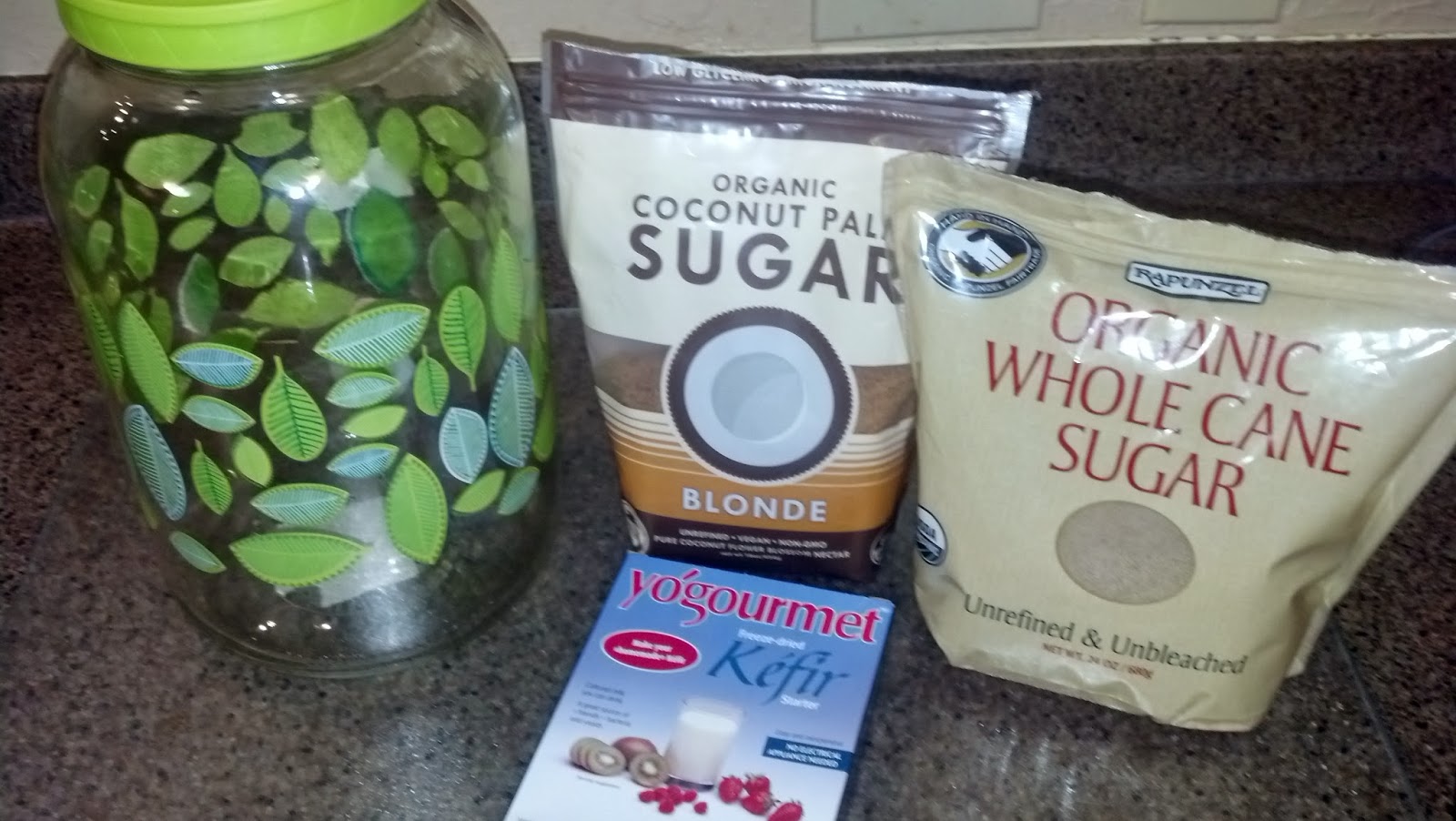


Kefir Water Recipe 
1 gal of Purified Water
2/3 c Coconut Palm Sugar
2/3 c Rapadura Sugar
1 1/2 c Kefir Culture or 2 packets of Kefir Starter
 Directions:Place all ingredients in a large jar, stir, cover and place in a dark warm place to allow the kefir to ferment for 24 hours. After 24 hours, strain the kefir (the grains at the bottom) and place in a sealed container and store in the refrigerator to use as a starter when making more kefir water.  Keep the kefir water in the refrigerator to maintain freshness.

Tuesday, November 5, 2013

Which is the Healthier Cracker?


Choosing a nutritious healthy cracker can be difficult these days.  Grocery stores carry many different brands and types of crackers and all of them claim to be healthy.  However, they carry preservatives and other chemicals that do not contribute to good nutrition.  I chose these three types of crackers because they appealed to my eye as nutritious.  And although I read the label for calories and ingredients I didn't have knowledge about the ingredient "TBHQ for freshness" and simply passed over it and made the purchase.


Nutrition wise, all three are around 70 calories, 2.5g fat, 11 total carbohydrates, and 1g protein.  The sodium level of the Multi-grain Crisps is a bit less at 110mg compared to 140mg for the other two and TBHQ free.   

Let's talk about the ingredient Tertiary Butylhydroquinone, or TBHQ as it is more commonly referred to as.  TBHQ is a synthetic antioxidant that is used to extend the shelf life of oily and fatty foods such as crackers and fast foods (e.g. fish fillet, hash browns and chicken nuggets.) It is also found in certain brands of pet foods, as well as in cosmetic and baby skincare products, varnish, lacquers and resins. Some of the concerns about TBHQ is its relationship to butane, a component of lighter fluid, and its link to other health problems such as cancerous precursors in the stomach, as well as causing DNA damage. 

When reading the label of foods, avoid ingredients such as: Propyl gallate, Octyl gallate, Dodecyl gallate,  tert-Butylhydroquinone-tBHQ,  Butylated hydroxyanisole-BHA, and  Butylated hydroxytoluene, BHT which are considered as harmful antioxidants. 

Safer alternatives are perhaps those including Ascorbic acid (vitamin C), Sodium ascorbate, Calcium ascorbate, Potassium ascorbate, Ascorbyl palmitate, and Mixed tocopherols (vitamin E) like  dl-a-Tocopherol, g-Tocopherol, d-Tocopherol.

So which is perhaps the safer cracker, I believe its the Multi-grain Crisps.  It includes more beneficial ingredients like quinoa, flax seeds, and brown rice and is gluten, wheat and milk free.  The Omega-3 in the flax seeds also gives it that added punch of nutrition!

Tuesday, October 1, 2013

Are You A Sugar Addict?


Do you have sugar cravings?  When you eat sugary treats do you find it hard to stop at just one?  Do you crave sweets even when you clearly know what it is doing to your body?  If you answered yes to these questions you are considered a sugar addict.  I know because this was me.  I've had a sugar addiction for years.  I tried several ways to either manage or stop my sugar cravings, but my battle would always end in defeat against sugar.  Only recently I listened to a lecture from Julia Ross, a pioneer in the field of nutritional psychology and the author of The Mood Cure and The Diet Cure  and it changed my life!

My moment of truth came when Julia describe sugar as a drug.  Yes, a Drug!   This triggered something in my brain.   Julia said that sugar affects the body in the same way as cocaine and heroine, but that sugar was four times more addictive than cocaine.   Sugar affects the body by raising serotonin and glucose levels.  It is tied to heart disease, fatty liver and is a major contributor to the increase of diabetes and obesity in America.  How?

We have abandoned traditional foods for sugary and processed foods.  Sugar and high fructose corn syrup has crept into nearly all our food supply.  From meats such as bacon, sausages, and sandwich meat to crackers, yogurt, ketchup, cereal, bread, you name it.  Even worst, the amount of sugar in our foods has increased.  Sodas and candy bars especially have twice the amount of sugar than 5 years ago.

The American Heart Association guidelines recommend the following daily sugar limit:
*Women: no more than 100 calories per day which equals 6 teaspoons or 24 grams
*Men: no more than 150 calories per day which equals 9 teaspoons or 36 grams


Be good to your body by paying more attention to the amount of sugar you consume daily.  Make a conscious decision to reach for healthier snacks that are nutritious and taste good.  Your body will thank you in the long run.

Monday, September 2, 2013

Health Benefits of Drinking Lemon Water


Lemon Water
FOOD FRUIT WATER

Drinking lemon water first thing in the morning can do wonders for your body.  Lemons are packed with natural vitamins and minerals that are key to your inner and outer beauty regime as well as your general health.  Lemons are high in vitamin C, thereby adding a healthy boost to your immune system.  Lemon water is a great tonic to the liver aiding in the releasing of toxins to prepare it for the toxins of the day.  If you are prone to water retention lemon water is a natural diuretic for reducing bloating and swelling.  Although lemons are acidic they have an alkaline affect in the body in balancing PH levels.  A benefit to having an alkaline body as opposed to acidic is clearer, softer, more supple skin.  I've been drinking lemon water for some time now and have noticed a big difference in my joints.   I have less pain, can bend my knees more easily, and have less swelling.  

Here's the recipe I use:

16 oz glass of purified water
1 Lemon (squeezed)


I don't use a sweetener, just plain ole lemon and water!